
Process of making Homeopathic Medicines

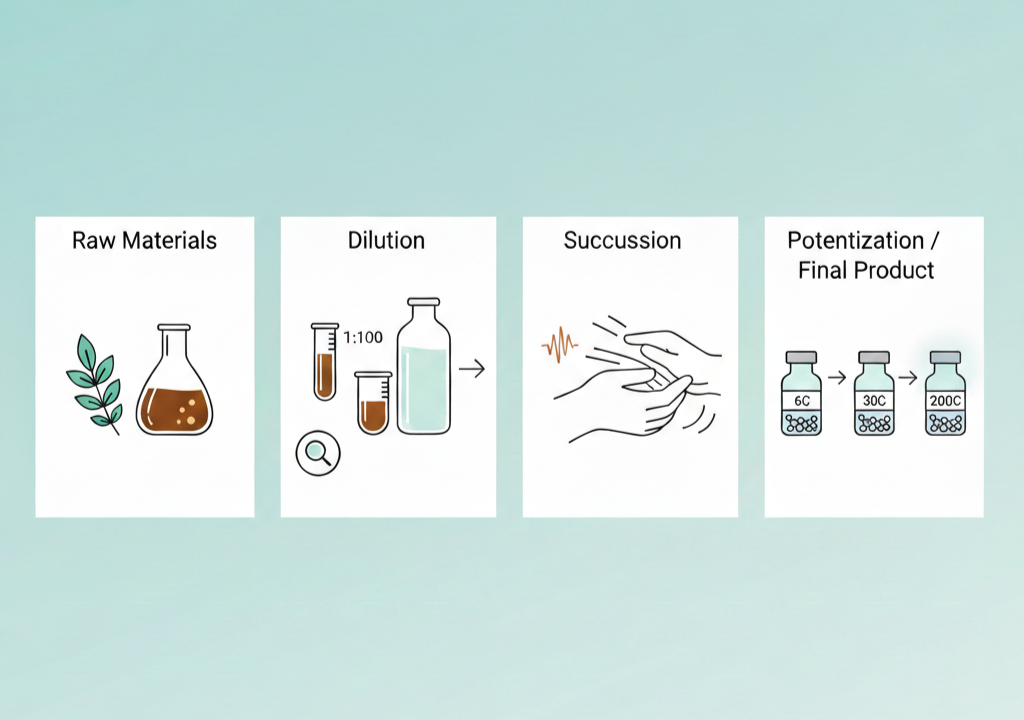
Homeopathic medicine is a natural system of treatment that uses highly diluted substances derived from plants, minerals, and animals. The preparation process is unique and follows strict pharmaceutical guidelines to ensure safety, consistency, and quality. Unlike conventional medicines, homeopathic remedies are prepared through a special method called potentization, which enhances their therapeutic properties while minimizing toxicity.
Sources of Homeopathic Medicines
Homeopathic remedies are prepared from three primary sources:
- Plant-based substances – such as Arnica, Belladonna, and Chamomile
- Mineral-based substances – such as sulfur, calcium, and phosphorus
- Animal-derived substances – such as bee venom (Apis mellifica)
Each substance undergoes careful identification, purification, and preparation before being used medicinally.
Step 1: Preparation of the Mother Tincture
The first stage in making a homeopathic medicine is creating the mother tincture.
- Plant materials are cleaned, chopped, and soaked in alcohol for a specific period.
- Mineral and animal substances may require grinding or processing before dilution.
This concentrated extract is the base from which further dilutions are made.
Step 2: Dilution
Homeopathic medicines are diluted systematically. There are different dilution scales, including:
- Centesimal scale (C) – 1 part substance to 99 parts alcohol or distilled water (1:100)
- Decimal scale (X or D) – 1 part substance to 9 parts diluent (1:10)
For example, a 6C potency means the substance has been diluted 1:100 six times in succession.
Step 3: Succussion (Potentization)
After each dilution step, the solution is vigorously shaken in a process called succussion.
This step is considered essential in homeopathy because it is believed to activate the medicinal properties of the substance. The combination of dilution and succussion is known as potentization.
Step 4: Preparation of Final Dosage Forms
Once the desired potency is achieved, the liquid remedy may be:
- Dispensed directly in liquid form
- Added to lactose-based sugar pellets
- Prepared as tablets or globules
These forms are easy to administer and generally have a long shelf life if stored properly.
Quality and Safety Standards
Reputable homeopathic manufacturers follow strict pharmaceutical guidelines, including:
- Controlled sourcing of raw materials
- Hygienic production environments
- Standardized dilution procedures
- Proper labeling and packaging
Because the remedies are highly diluted, they are generally considered low-risk when used appropriately under professional supervision.
Conclusion
The preparation of homeopathic medicines is a precise and carefully regulated process that involves extraction, systematic dilution, and potentization. This unique method distinguishes homeopathy from conventional medicine and aims to provide gentle, individualized treatment.
For safe and effective use, homeopathic remedies should always be taken under the guidance of a qualified practitioner.












This is best Article.